
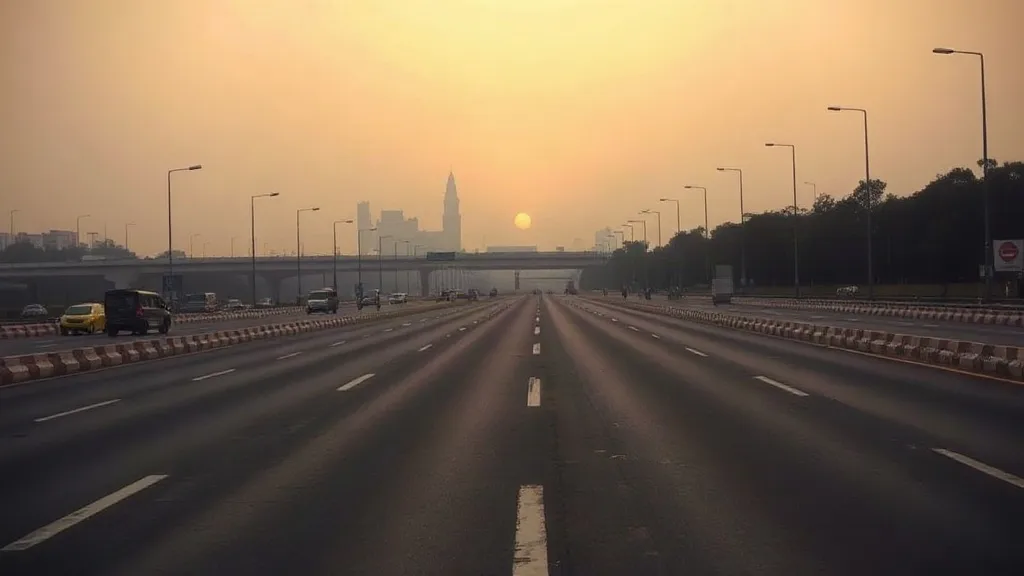
Commuters in the capital woke up to a familiar ritual on Wednesday: a fresh traffic advisory, a list of roads to avoid, and the quiet calculation of how much earlier to leave home. This time the trigger is a planned stir against the SIR exercise, with farmers' organisations and a newly formed civil society platform calling on supporters to march, and Delhi Police moving pre-emptively to keep the city's already stretched arteries from seizing up.
The advisory is not unusual in itself. What makes this moment worth watching is the breadth of the coalition behind the protests. It is not a single union or a single district. It is a coming-together of agricultural groups, trade unions and civic outfits, which is precisely the kind of combination that tends to turn a one-day demonstration into something longer and harder to manage.
What the SIR Exercise Actually Is, and Why It Has Drawn Anger
SIR, or Special Intensive Revision, is the process by which electoral rolls are scrutinised, entries verified and doubtful names flagged for further inquiry. On paper it is a housekeeping exercise, the kind of administrative hygiene that most citizens would struggle to object to. In practice, the way it is rolled out matters enormously, and that gap between the paper version and the lived version is where the controversy lives.
The objections raised by the protesting groups cluster around a few themes. First, the burden of proof. When a voter is asked to produce documents to defend an entry that has stood for years, the onus shifts in a way that feels punitive rather than corrective. Second, the timing and the manner of verification, which critics argue can leave legitimate voters anxious and, in some cases, effectively sidelined. Third, the absence of what the groups describe as adequate transparency about how objections are adjudicated and how names are restored if a flag turns out to be an error.
Supporters of the exercise counter that cleaning up rolls is a legitimate public interest, that duplication and outdated entries are real problems, and that verification is not the same as deletion. Both claims can be true at once, and that is what makes the dispute so difficult to resolve through slogans. The Special Intensive Revision is an administrative process; how it is experienced by the people at the receiving end is a political question.
Who Is Behind the Stir
Two names anchor the mobilisation. The Samyukt Kisan Morcha, the coalition of farmers' organisations that became a household reference point during the long agitation over agricultural laws, is among those backing the protest. Alongside it stands a platform called People Against SIR, which has positioned itself as a broader civic front rather than a purely agrarian one.
That second element is significant. By framing the objection as a citizen's concern rather than a farmers' concern, the organisers widen the tent. Trade unions and civil society organisations have pledged their support, which means the crowds on the day could include factory workers, activists, students and ordinary residents who have never held a plough but who worry about their own names on a list.
The stated aim is a nationwide protest, not a Delhi-only event. That matters for how the capital prepares. When a stir is national in ambition but concentrated in the capital in its most visible form, the pressure point is Delhi's roads, Delhi's police bandwidth and Delhi's political symbolism.
What the Traffic Advisory Means for You
Delhi Police advisories tend to follow a recognisable pattern, and reading them properly saves real time. The usual ingredients are route restrictions around the protest site, diversions for heavy and commercial vehicles, planned barricades at approach roads, and a request to use public transport where possible.
What the advisory does not always spell out is the ripple effect. A diversion on one arterial road pushes traffic onto parallel roads that were never designed for the extra load, and the congestion cascades outward for kilometres. If your commute crosses the central districts, the practical advice is to assume delay rather than hope for the best.
- Check the advisory on the morning of the protest rather than the night before, since routes are often revised.
- Build a buffer of at least forty-five minutes into any journey that touches the affected corridors.
- Prefer the metro for cross-city trips; rail is largely insulated from road diversions.
- If you drive, keep identification and vehicle papers handy, since checkpoints are common near protest zones.
- Avoid arguing with barricades. Diversions are operational decisions made on the ground and they change by the hour.
The School and Office Question
Delhi has learned, sometimes painfully, that a protest in the wrong place at the wrong hour can strand children and employees. Institutions in the affected zones often wait for an official signal before announcing closures or shifts to online work. Parents and employees should watch for institutional messages rather than relying solely on the traffic advisory, because the two are issued by different authorities and rarely arrive at the same moment.
Why This Protest Is Being Watched So Closely
There is a specific memory at work here. The farmers' movement of recent years demonstrated that a sustained, well-organised agitation can reshape national policy and dominate the news cycle for months. Any coalition that includes the Samyukt Kisan Morcha is therefore read through that lens, whether or not the current stir intends to last that long.
The second reason is the subject. Electoral rolls sit at the foundation of democratic legitimacy. A dispute over how names are added, verified and removed touches something more fundamental than a road closure or a subsidy demand. When people believe their place on the roll is being questioned unfairly, the grievance travels further and faster than almost any other kind of complaint.
The third reason is the coalition's shape. An alliance of farmers, trade unions and civic platforms is harder to dismiss as a narrow interest group. It also creates internal complexity: different constituents have different red lines, and keeping them aligned requires constant negotiation. That fragility is worth noting, because it cuts both ways. It can make the movement broad, and it can make it brittle.
A Practical Word on the Ground Reality
Protest days in Delhi rarely unfold exactly as advertised. Crowd sizes fluctuate, routes shift, and a planned march can turn into a static sit-in or vice versa. The police advisory is a best estimate, not a guarantee. The most useful mindset is flexible: know your alternative route, know your alternative mode of transport, and decide early whether the trip is essential.
For businesses in the affected areas, the calculus is different. Delivery schedules, client meetings and staff attendance all need contingency planning. A short internal note the evening before, listing who can work remotely and which deliveries can be rescheduled, is worth more than a scramble on the day itself.
Frequently Asked Questions
What is the SIR exercise that people are protesting against?
SIR stands for Special Intensive Revision, a process of scrutinising and verifying electoral roll entries. The protests focus not on the idea of clean rolls but on how verification is carried out, how voters are asked to prove their eligibility, and how transparent the correction process is.
Which groups are supporting the protest against SIR?
The Samyukt Kisan Morcha, a coalition of farmers' organisations, and a civic platform called People Against SIR are among the principal backers. Various trade unions and civil society organisations have also pledged support, which broadens the protest beyond a purely agricultural base.
Will the Delhi protest affect traffic across the whole city?
Not uniformly. Disruption concentrates around the protest site and the approach roads named in the police advisory. However, diversions push traffic onto parallel routes, so congestion can spread well beyond the immediate area. Cross-city journeys are the most likely to be affected.
How should commuters prepare on the day of the stir?
Check the advisory on the morning itself, allow generous extra time, and use the metro for journeys that cross the affected districts. Keep vehicle documents handy near checkpoints and avoid confrontation at barricades, since ground-level diversions change quickly.
Is the protest expected to be limited to Delhi?
The organisers have framed the action as nationwide, with the capital serving as the most visible stage. That means disruptions may occur in other cities as well, and local advisories in those places are worth monitoring separately.