
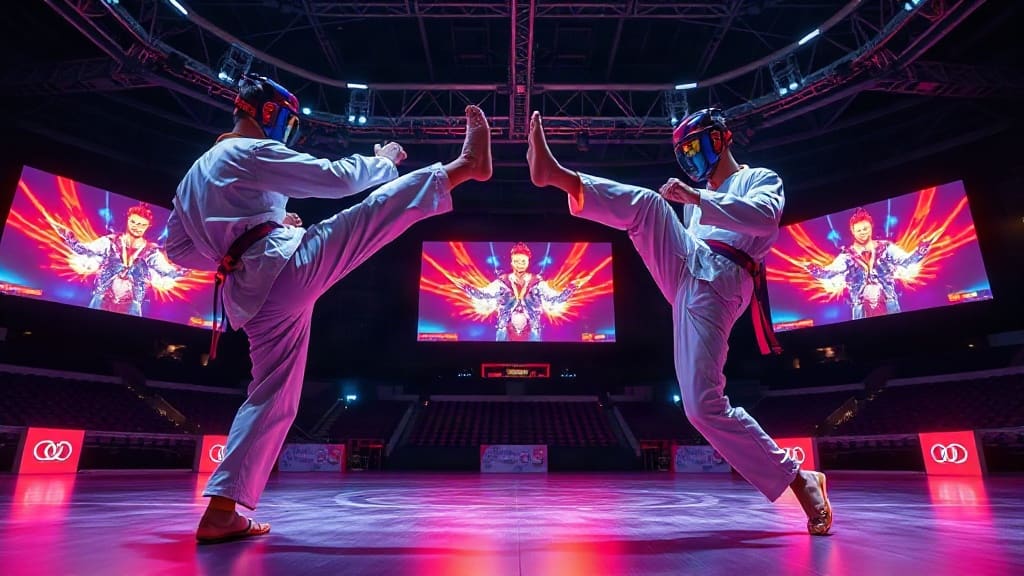
When you imagine taekwondo, you probably picture lightning-fast kicks, powerful punches, and the satisfying thud of a well-placed strike. But at this year's Asian Games, a new version of the sport is turning that image on its head. Virtual taekwondo removes the physical contact entirely, replacing it with motion sensors, avatars, and a digital arena. The debut of this contactless format has ignited a fierce debate: is it a bold step into the future of martial arts, or just a glorified video game?
What Is Virtual Taekwondo and How Does It Work?
Virtual taekwondo is not simply playing a taekwondo video game on a console. It is a carefully designed competitive system that uses motion-tracking technology to translate real-world kicks and punches into in-game actions. Athletes wear lightweight sensors on their bodies and stand in a designated space. When they execute a technique, the sensors capture the speed, angle, and power, and the system scores the move based on predefined criteria.
The most striking difference from traditional taekwondo is the absence of physical contact. There is no opponent trying to hit you back. Instead, each athlete faces a screen where their virtual avatar mirrors their movements and competes against the opponent's avatar in a digital ring. The goal is still to score points through accurate and powerful techniques, but the risk of injury from direct impact is eliminated.
The technology behind virtual taekwondo has been in development for several years, and its inclusion in the Asian Games marks a significant milestone. The Asian Games, a multi-sport event second only to the Olympics in scale, provides a global stage for this experimental format. Organizers hope that by showcasing virtual taekwondo, they can attract a younger, tech-savvy audience and demonstrate that traditional sports can evolve with the times.
The Road to the Asian Games: From Concept to Competition
The journey of virtual taekwondo to the Asian Games has been gradual. The World Taekwondo Federation, the sport's international governing body, has been exploring ways to modernize the sport and make it more accessible. Traditional taekwondo requires a dojang, protective gear, and a trained opponent. Virtual taekwondo, by contrast, can be practiced in a smaller space with minimal equipment. This accessibility is a key selling point, especially in urban areas where space is limited.
Early demonstrations of virtual taekwondo took place at various international events, drawing curiosity and skepticism in equal measure. Some traditionalists argued that removing contact strips the sport of its essence. After all, taekwondo is a martial art rooted in self-defense and combat. Without the threat of a real counterattack, critics say, the sport loses its strategic depth and becomes a test of choreography rather than fighting skill.
However, proponents counter that virtual taekwondo is not meant to replace traditional taekwondo but to complement it. They point out that the virtual format can serve as an entry point for newcomers who may be intimidated by full-contact sparring. It also offers a safer alternative for older athletes or those recovering from injuries. Moreover, the digital scoring system reduces the subjectivity that sometimes plagues traditional judging, potentially making competitions fairer and more transparent.
Athlete Perspectives: Embracing the New Format
For athletes who have competed in both traditional and virtual taekwondo, the experience is markedly different. In traditional sparring, you must constantly read your opponent's body language, anticipate their next move, and manage your own physical fatigue and pain. Virtual taekwondo removes the physical pain but introduces a new set of challenges. The motion sensors are highly sensitive, and even a slight deviation in technique can result in a missed point. This demands a high level of precision and consistency.
Some athletes have noted that virtual taekwondo can actually improve certain aspects of their traditional game. Because the system rewards clean technique and proper form, it encourages athletes to refine their movements. The instant feedback on screen allows for rapid adjustment, which can accelerate learning. Additionally, the gamified elements, such as avatars and visual effects, make training more engaging for younger athletes who have grown up with video games.
On the other hand, some competitors miss the adrenaline rush of real combat. The psychological pressure of facing an opponent who can physically hurt you is absent in the virtual arena. For many martial artists, that pressure is an essential part of the sport's character. Without it, the competition feels less intense and, for some, less meaningful.
The Technology Behind the Contactless Combat
The core of virtual taekwondo lies in its motion capture and scoring system. While the exact specifications may vary depending on the provider, the general principle is consistent. Athletes wear sensors on their wrists, ankles, and torso. These sensors communicate wirelessly with a central processing unit that calculates the speed, acceleration, and trajectory of each limb movement.
The scoring system is based on the same criteria as traditional taekwondo: kicks to the head and body earn more points than punches, and spinning kicks earn additional points. However, in the virtual version, the system automatically detects whether a technique would have landed on a real opponent. This is achieved by projecting the athlete's movements onto a virtual opponent model and calculating the intersection points. If a kick is too slow or poorly aimed, it may not register as a scoring hit, even if the movement looks impressive to the naked eye.
One of the technological challenges is ensuring fairness and consistency across different hardware setups. Factors such as sensor calibration, environmental interference, and even the athlete's body type can affect accuracy. To address these concerns, organizers have implemented strict equipment standards and pre-competition calibration procedures. Despite these efforts, technical glitches do occur, and some matches have been marred by disputed scoring decisions caused by sensor errors.
The Debate: Sport, Game, or Something In Between?
The most heated discussions about virtual taekwondo revolve around its classification. Is it a legitimate sport, a video game, or a hybrid of both? Critics argue that the absence of physical contact fundamentally changes the nature of the activity. In traditional taekwondo, the risk of injury is real, and managing that risk is part of the skill set. A fighter must learn to defend, evade, and absorb blows. Virtual taekwondo eliminates all of that, reducing the sport to a test of technique execution against a static opponent.
Supporters counter that many established sports have non-contact versions that are still considered legitimate. For example, flag football removes tackling but retains the core elements of American football. Similarly, virtual taekwondo retains the kicking and punching techniques, the scoring system, and the competitive format. The physical execution of a kick is identical; only the target is virtual. Therefore, they argue, virtual taekwondo is more than just a video game because it requires real athletic skill, not just button presses.
The comparison to esports is inevitable. Esports have gained massive popularity and are now recognized as legitimate competitions, with professional players, leagues, and even inclusion in some multi-sport events. Virtual taekwondo sits at the intersection of esports and traditional sport. It requires physical exertion and martial arts proficiency, but it also relies heavily on digital technology. This hybrid nature is both its greatest strength and its most significant point of contention.
Potential Impact on the Future of Combat Sports
If virtual taekwondo proves successful at the Asian Games, it could pave the way for similar contactless versions of other combat sports. Boxing, karate, and even mixed martial arts could theoretically adopt virtual formats to reduce injury risk and broaden participation. This could lead to a new category of sports that blend physical skill with digital simulation.
However, such a shift would not be without consequences. Traditional martial arts have deep cultural and historical roots. The discipline, respect, and philosophy that accompany training are integral to the experience. A purely digital version might attract individuals who are interested only in the competitive aspect, potentially diluting the cultural significance. Furthermore, the rise of virtual formats could divert resources and attention away from traditional training, potentially affecting the development of elite athletes in the full-contact version.
Another consideration is the spectator experience. Traditional taekwondo matches are dynamic and visceral, with the tension of potential knockouts and the drama of physical exchanges. Virtual taekwondo, while visually interesting, may lack that raw intensity. However, the digital format offers opportunities for enhanced viewing experiences, such as augmented reality overlays, real-time statistics, and interactive elements that could appeal to a younger audience.
What to Watch During the Asian Games Debut
For those curious about virtual taekwondo, the Asian Games competition will be a fascinating test case. Observers should pay attention to several key aspects. First, the accuracy and reliability of the scoring system will be under scrutiny. Any significant technical failures could undermine the credibility of the format. Second, the level of athleticism on display will be telling. If the competitors demonstrate high-level technique and fitness, it will support the argument that virtual taekwondo is a real sport. Finally, the audience reaction, both in the venue and online, will provide insight into the format's appeal and potential for growth.
The inclusion of virtual taekwondo in the Asian Games is a bold experiment. It challenges our assumptions about what constitutes a sport and how technology can reshape traditional activities. Whether it will be embraced as a legitimate evolution or dismissed as a gimmick remains to be seen. One thing is certain: the conversation it has sparked is far from over.
Frequently Asked Questions
Is virtual taekwondo safe for all ages?
Virtual taekwondo is generally considered safer than traditional full-contact sparring because there is no physical impact. However, athletes can still experience muscle strains or joint injuries from executing powerful kicks without proper warm-up or technique. It is suitable for a wide range of ages, but proper supervision and training are recommended, especially for beginners.
Can virtual taekwondo help improve my traditional taekwondo skills?
Yes, many practitioners find that virtual taekwondo helps improve precision and consistency. The system provides immediate feedback on technique, which can help you refine your movements. It also encourages proper form, as sloppy techniques often fail to register as scoring hits. However, it does not develop defensive skills or the ability to read an opponent, which are crucial in traditional sparring.
What equipment is needed to compete in virtual taekwondo?
Competitors typically need motion sensors worn on the body, a compatible display screen, and the virtual taekwondo software. The exact equipment specifications may vary depending on the competition organizer. At the Asian Games, standardized equipment is provided to ensure fairness. For home practice, consumer versions of virtual taekwondo systems are becoming increasingly available.
Will virtual taekwondo be included in the Olympics?
There is no official announcement regarding virtual taekwondo's inclusion in the Olympics. Its debut at the Asian Games is a significant step, and if it proves successful, it could be considered for future multi-sport events. However, Olympic inclusion requires approval from the International Olympic Committee and involves a lengthy evaluation process.
How is virtual taekwondo scored compared to traditional taekwondo?
Virtual taekwondo uses a similar scoring system to traditional taekwondo, with points awarded for kicks and punches based on target area and technique difficulty. The key difference is that the scoring is automated, using motion sensors to determine if a technique would have landed on a virtual opponent. This reduces human error but introduces potential technical glitches that can affect accuracy.