
When you hear the name Danny Boyle, you probably think of raucous energy, pounding soundtracks, and stories that refuse to sit still. From the Edinburgh drug dens of Trainspotting to the Mumbai slums of Slumdog Millionaire, Boyle has a gift for turning messy real life into cinematic adrenaline. His latest work, Ink, which opened the Venice Film Festival on Wednesday, takes that same restless spirit and aims it at a very different kind of chaos: the birth of the modern tabloid press. The film is a rollicking, provocative, and surprisingly moral exploration of how a newspaper built on scandal and sensation managed to capture the public imagination, and what that says about all of us who bought it.
Set in London in the late 1960s and early 1970s, Ink tells the story of The Sun, the British tabloid that transformed from a struggling broadsheet into a cultural juggernaut under the ownership of Rupert Murdoch and the editorial leadership of Larry Lamb. The film doesn't shy away from the grubbier details: the topless models, the fabricated exclusives, the relentless pursuit of celebrity gossip, and the bare-knuckle competition with rival tabloids. But Boyle, working from a script by James Graham, isn't interested in simple moralizing. Instead, he invites us to see the tabloid revolution as a Faustian bargain between publishers, editors, journalists, and the reading public. The result is a film that feels less like a history lesson and more like a mirror held up to our own appetites.
The Allure of Scandal and the Price of Attention
At its core, Ink examines a deceptively simple question: why do we read things we know are bad for us? The tabloid formula seems almost quaint today in an era of algorithmically amplified clickbait and social media outrage. But in the 1970s, it was genuinely revolutionary. The Sun under Lamb didn't just report the news; it manufactured a daily dose of outrage, titillation, and vicarious thrills. The paper's famous Page 3, featuring a topless model, became a cultural lightning rod. Its campaigns, from attacking trade unions to championing the Falklands War, blurred the line between journalism and propaganda. And its relentless pursuit of celebrities, politicians, and ordinary people caught in extraordinary circumstances created a template that still shapes media today.
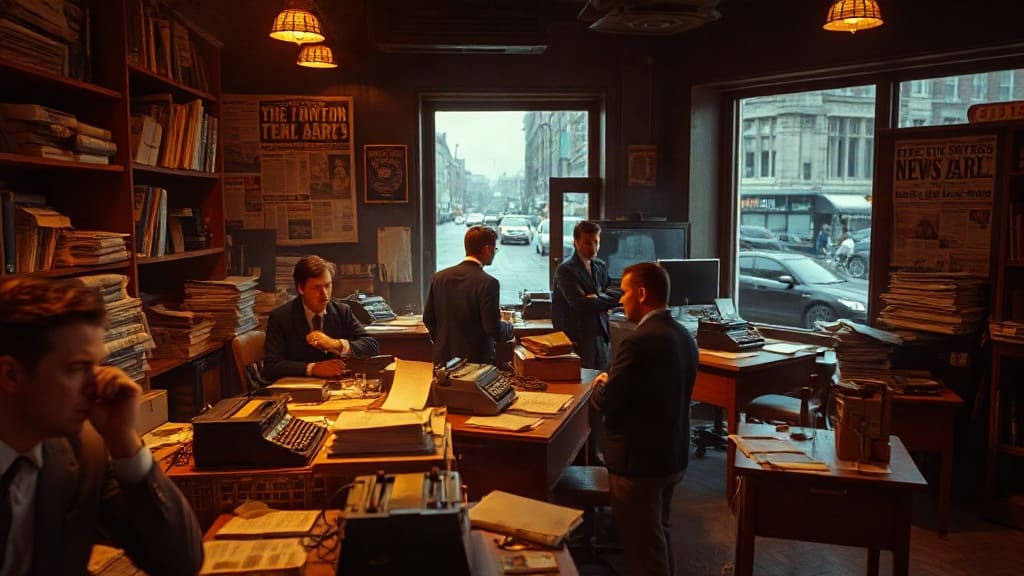
Boyle's film captures this transformation with his signature visual flair. The newsroom scenes crackle with energy, as reporters shout over each other, typewriters clatter, and headlines are born in a frenzy of competition. The camera swoops and dives through the offices of The Sun, making the paper's rise feel like a heist movie or a rock and roll biopic. But beneath the excitement, there's a steady undercurrent of unease. The film shows how easily principles can be traded away for circulation, and how quickly a culture of sensationalism can become self-perpetuating.
The Human Cost Behind the Headlines
While Ink is often darkly funny, it doesn't ignore the real people caught in the tabloid machine. The film dramatizes the pressure on reporters to deliver ever more outrageous stories, the toll on families of those hounded by paparazzi, and the ethical compromises made by editors who convinced themselves they were simply giving the public what it wanted. One of the film's most poignant moments comes when a journalist realizes that a story he chased for weeks has destroyed an innocent person's life. The paper's response? A shrug and a demand for the next scoop.
This human dimension is what elevates Ink beyond a mere nostalgia trip. It forces audiences to confront the reality that tabloid journalism is not a victimless crime. Every sensational headline has a backstory, and every invasion of privacy leaves scars. The film doesn't absolve the public either. It suggests that our collective appetite for scandal, our willingness to click and read and gossip, is what ultimately sustains the tabloid industry. We are not passive consumers; we are active participants.
Lessons for the Digital Age
Watching Ink in 2025, it's impossible not to draw parallels with our current media landscape. The tabloid wars of the 1970s were a precursor to today's battle for clicks, likes, and shares. The tactics have changed, but the underlying dynamics remain the same. Sensationalism still sells. Outrage still drives engagement. And the line between news and entertainment is blurrier than ever. The film's central questions feel urgently relevant: What responsibility do media organizations have to the public? What responsibility do audiences have to themselves? And can a free press survive if it's driven primarily by profit?
Ink offers no easy answers, which is precisely why it's worth watching. Boyle and Graham resist the temptation to turn the film into a simple morality tale. Instead, they present a complex portrait of flawed people making bad decisions in pursuit of success, power, and relevance. The result is a film that entertains, provokes, and lingers in the mind long after the credits roll. It's a reminder that the stories we tell ourselves about journalism matter, because they shape how we understand the world and our place in it.
Why Venice Matters for 'Ink'
Opening the Venice Film Festival is a significant honor, and it positions Ink as a major contender in the upcoming awards season. Boyle has a long history with the festival; his previous films have premiered there to critical acclaim. The choice of Ink as the opening night film signals that the festival's programmers see it as both artistically ambitious and culturally relevant. The film's blend of historical drama, sharp satire, and moral inquiry is exactly the kind of work that tends to generate awards buzz. And with its timely subject matter, it's likely to spark conversations far beyond the Lido.
For audiences, Ink is a chance to experience a master filmmaker at the top of his game. Boyle's direction is as kinetic and inventive as ever, but there's a new maturity here, a willingness to sit with complexity rather than rush past it. The performances are uniformly strong, with the actors bringing nuance to characters who could easily have become caricatures. And the screenplay crackles with wit and intelligence. It's a film that respects its audience enough to ask hard questions without pretending to have all the answers.
The Enduring Power of the Tabloid Story
In the end, Ink is about more than one newspaper or one era. It's about the seductive power of storytelling, and the ways in which we use stories to make sense of a chaotic world. Tabloids, at their best and worst, offer a kind of narrative clarity. They reduce complex issues to simple moral battles, they turn celebrities into gods and monsters, and they give us villains to hate and heroes to cheer. This is powerful stuff, and it's not going away. The platforms may change, but the appetite for juicy stories remains constant.
Boyle's film is a reminder that we should be more conscious of what we consume and why. It asks us to consider the consequences of our curiosity, and to recognize that the choices we make as readers and viewers have real-world effects. Ink is not just a film about the past; it's a warning about the future. And it's a damn entertaining one at that.
Frequently Asked Questions
Is 'Ink' based on a true story?
Yes, Ink is based on real events surrounding the rise of The Sun newspaper in the United Kingdom during the late 1960s and 1970s. The film dramatizes the paper's transformation under the leadership of editor Larry Lamb and its impact on British media and culture. While some characters and scenes are composites or fictionalized for dramatic effect, the core story is rooted in historical fact.
Who stars in Danny Boyle's 'Ink'?
The film features a strong ensemble cast, though specific casting details may vary depending on the production. The lead roles are played by accomplished British actors who bring depth and energy to the characters of Larry Lamb, Rupert Murdoch, and the journalists who shaped The Sun's editorial voice. For the most current cast list, it's best to check the official film materials or recent reviews from the Venice premiere.
What themes does 'Ink' explore?
Ink explores themes of media power, journalistic ethics, the commodification of news, and the public's complicity in scandal culture. It examines how the pursuit of circulation and profit can erode journalistic standards, and how sensationalism shapes public discourse. The film also touches on issues of class, celebrity, and the changing nature of British society in the 1970s.
When will 'Ink' be released in theaters?
Following its premiere at the Venice Film Festival, Ink is expected to receive a wider theatrical release in the coming months. Exact release dates may vary by country, so it's a good idea to keep an eye on official announcements from the film's distributor. Given the festival buzz, it's likely to be a significant release for awards season.
How does 'Ink' compare to other Danny Boyle films?
While Ink shares Boyle's signature stylistic energy and kinetic camerawork, it is more focused on dialogue and character dynamics than some of his earlier films. It has the satirical bite of Trainspotting but with a historical and political weight that feels closer to Steve Jobs or 127 Hours. Fans of Boyle's work will recognize his fingerprints, but the subject matter gives the film a distinctive tone.