
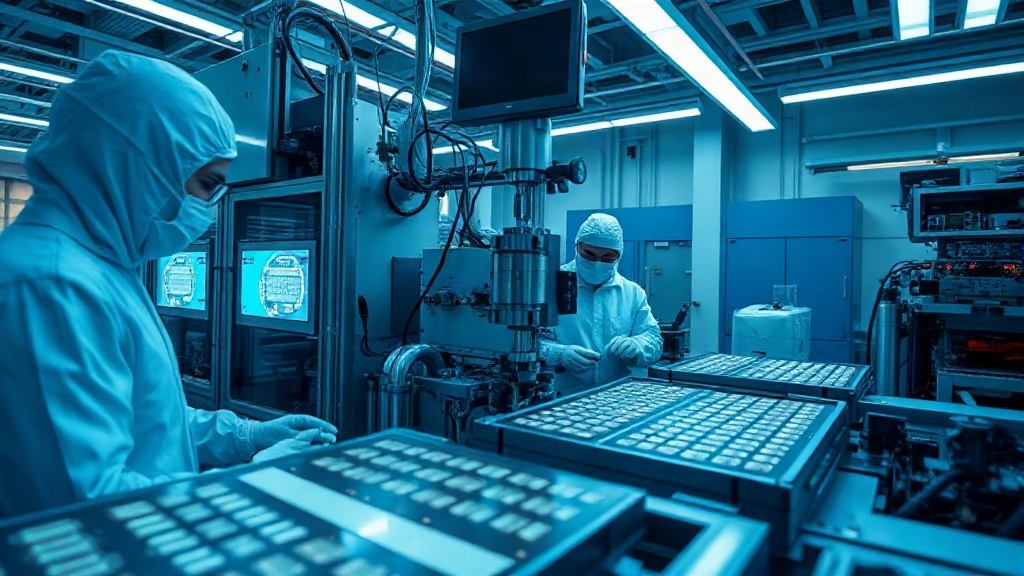
For years, China's memory storage industry has been synonymous with assembling imported chips into modules. Companies would buy NAND flash and DRAM from global giants like Samsung, SK Hynix, and Micron, package them into USB drives or SSDs, and sell them under their own brands. It was a volume business with thin margins, but it kept factories humming. Now, a quiet but significant shift is underway: Chinese storage makers are pushing into advanced packaging, a move that could reshape their role in the global semiconductor supply chain.
The latest signal comes from Biwin Storage Technology, a Shanghai-listed company that recently announced a 4.5 billion yuan (about US$672 million) investment in the third phase of its advanced packaging and testing project in Dongguan, Guangdong province. That's more than the 3.09 billion yuan it spent on the first two phases combined. The scale of the bet underscores a broader ambition: to stop being just a module assembler and start capturing value from wafer-level operations, where chips are diced, stacked, and interconnected at the nanoscale.
Why advanced packaging is the new battleground
Advanced packaging has become a buzzword in the semiconductor world, and for good reason. As Moore's Law slows, squeezing more performance out of chips increasingly depends on how you package them. Techniques like through-silicon vias (TSVs), fan-out wafer-level packaging, and 2.5D/3D stacking allow multiple chips to be integrated into a single package, boosting speed and energy efficiency. For memory makers, this is especially critical: high-bandwidth memory (HBM) and other advanced DRAM stacks rely on cutting-edge packaging to feed data-hungry AI processors.
Historically, Chinese companies have been largely absent from this high-value segment. The advanced packaging market has been dominated by firms like TSMC, Amkor, and ASE, with China's OSATs (outsourced semiconductor assembly and test providers) focused on lower-end wire-bond packaging. But that's changing. Companies like JCET, Tongfu Microelectronics, and Huatian Technology have been investing in advanced packaging lines, and now module makers like Biwin are joining the fray.
For Biwin, the move into wafer-level packaging is a strategic pivot. The company started as a memory module manufacturer, buying wafers from others and turning them into consumer SSDs. By bringing packaging and testing in-house, it can control more of the production process, reduce costs, and potentially develop custom solutions for niche markets like industrial or automotive storage. The Dongguan project is designed to handle wafer-level packaging, which means Biwin will be able to process wafers directly, not just assemble pre-packaged chips.
The road from module maker to integrated player
Climbing the value chain is easier said than done. Advanced packaging requires deep expertise in materials science, thermal management, and precision engineering. It also demands heavy capital investment: a single wafer-level packaging line can cost hundreds of millions of dollars, and the equipment is often subject to export controls. The U.S. has tightened restrictions on China's access to advanced chipmaking tools, including some used in packaging, which could complicate these ambitions.
Yet the incentives are strong. Module assembly is a low-margin business, with prices often dictated by the cost of NAND and DRAM chips. By contrast, advanced packaging can command premiums of 20-30% or more, especially for applications like AI accelerators, high-performance computing, and 5G infrastructure. Moreover, as China pushes for self-sufficiency in semiconductors, local companies are being encouraged to build up domestic capabilities. Government subsidies and preferential policies have played a role in enabling these investments.
Biwin's project in Dongguan is part of a larger trend. In recent years, several Chinese storage companies have announced packaging expansions. For instance, Longsys, another major memory module maker, has been investing in its own packaging and testing facilities. The goal is not just to serve the domestic market but to become competitive globally. Chinese memory brands like Netac, Ramaxel, and Biwin itself have already made inroads in consumer markets, and advanced packaging could help them move into enterprise and industrial segments where reliability and performance matter more.
What it means for the global supply chain
If Chinese storage makers succeed in advanced packaging, the implications could be far-reaching. For one, it would reduce their dependence on foreign OSATs and packaging houses. Currently, many Chinese memory chips are sent to Taiwan or Southeast Asia for advanced packaging, adding cost and time. Building domestic capacity would shorten the supply chain and make it more resilient to geopolitical disruptions.
Second, it could intensify competition in the memory market. Chinese companies have already disrupted the market for lower-end NAND and DRAM, putting pressure on prices. If they can offer advanced packaging for high-end memory, they could challenge the dominance of Samsung, SK Hynix, and Micron in segments like HBM. That's still a long way off, but the direction is clear. The Chinese government has identified advanced packaging as a key technology for its semiconductor self-sufficiency drive, and companies are responding.
Third, it could lead to new collaborations and partnerships. Advanced packaging often requires close coordination between chip designers, foundries, and packaging houses. Chinese companies are increasingly working together to develop domestic solutions. For example, memory makers are teaming up with foundries like SMIC and Hua Hong to co-develop packaging technologies. These partnerships could accelerate innovation and help Chinese firms catch up.
The challenges ahead
Despite the optimism, the path to advanced packaging leadership is fraught with obstacles. The technology is complex, and Chinese firms are still learning. Yield rates for advanced packaging can be low initially, and customers are reluctant to adopt unproven solutions. Building a reputation for quality and reliability takes time. Moreover, the global market is dominated by established players with decades of experience and strong customer relationships.
Export controls are another wild card. The U.S. has restricted China's access to advanced lithography equipment, and there are concerns that packaging tools could be next. While advanced packaging is less dependent on cutting-edge lithography, it still requires specialized equipment like wafer bonders and inspection systems, some of which come from American or Japanese suppliers. If restrictions tighten, Chinese companies may struggle to scale up.
Talent is also a bottleneck. Advanced packaging requires skilled engineers who understand both materials and process integration. China has been investing in semiconductor education, but there's still a shortage of experienced professionals. Companies like Biwin will need to attract and retain top talent, often competing with larger firms like Huawei and SMIC.
Finally, the economics are challenging. Advanced packaging lines are capital-intensive, and utilization rates need to be high to be profitable. In a downturn, memory prices fall, and packaging demand drops. Companies must be able to weather cycles. Biwin's investment is a long-term bet, and it may take years before it pays off.
What to watch next
The progress of Biwin's Dongguan project will be a key indicator. If it succeeds, it could encourage other module makers to follow suit. Keep an eye on announcements from companies like Longsys, Ramaxel, and Netac. Also watch for partnerships between memory makers and foundries, as well as any changes in export control policies that could impact packaging equipment.
For global players, the rise of Chinese advanced packaging is a double-edged sword. It could create new competition, but it also opens opportunities for collaboration and equipment sales. The memory industry is cyclical, and today's challengers can become tomorrow's partners. What's clear is that China's storage makers are no longer content with just assembling modules. They want a seat at the high-value table, and they're willing to spend billions to get there.
Frequently Asked Questions
What is advanced packaging in semiconductors?
Advanced packaging refers to techniques that connect and protect multiple chips in a single package, often using wafer-level processes like through-silicon vias (TSVs) and fan-out packaging. It improves performance, reduces size, and lowers power consumption compared to traditional wire-bond packaging.
Why are Chinese storage makers investing in advanced packaging?
They aim to move up the value chain from low-margin module assembly to higher-margin packaging and testing. This reduces reliance on foreign suppliers, shortens supply chains, and allows them to compete in high-end markets like AI and data centers.
How does Biwin's investment compare to others?
Biwin's 4.5 billion yuan investment in its Dongguan project is significant, exceeding its previous two phases combined. Other Chinese companies like Longsys and JCET are also investing, but Biwin's move is notable because it's a module maker expanding into wafer-level packaging.
What challenges do Chinese firms face in advanced packaging?
They face technical hurdles, high capital costs, potential export controls on equipment, and a shortage of skilled talent. Competing with established players like TSMC and Amkor is also difficult.
How could this impact the global memory market?
If successful, it could increase competition in high-end memory segments, reduce China's dependence on foreign packaging, and potentially lead to new partnerships. However, it may take years to see significant market impact.