
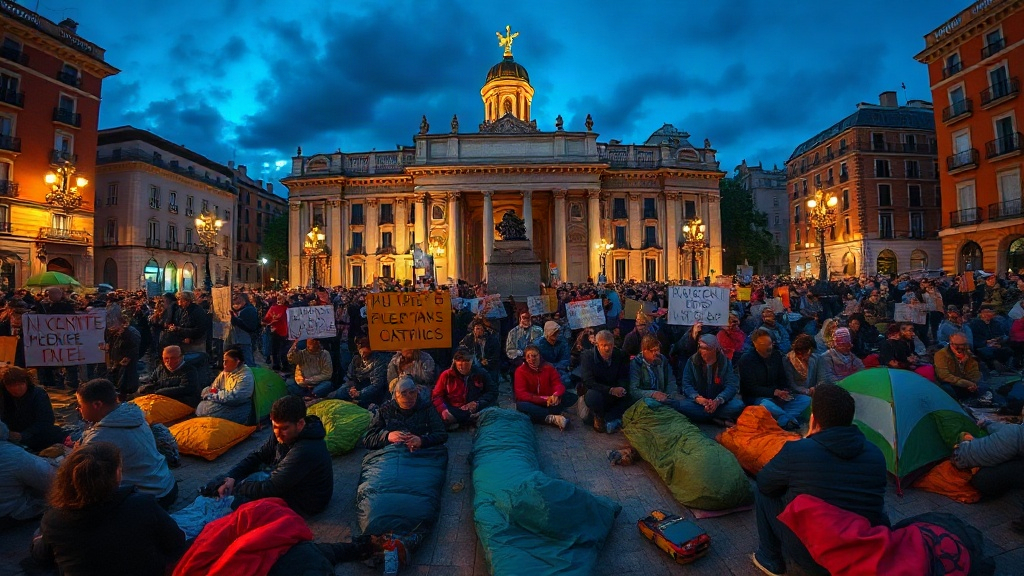
The image is searing: an 87-year-old woman, Maricarmen Abascal, carried out of her home on a stretcher, surrounded by police and protesters. She had lived in that Madrid apartment for nearly seventy years. Within days, her eviction became a flashpoint for a nationwide reckoning over housing in Spain. Tens of thousands marched through the capital, rattling keys, demanding change. Some pitched tents in Sol plaza, vowing to stay until housing becomes a right, not a luxury. The episode has thrust Spain's deepening housing crisis into the spotlight, revealing a tangle of rising rents, speculative investment, and inadequate tenant protections that have been building for years.
What Happened in Madrid?
Maricarmen Abascal's eviction was not an isolated incident. It was the culmination of a legal battle between her family and a property investment firm that had acquired the building. According to reports, the company sought to reclaim the apartment, and despite appeals, a court ordered the eviction. When bailiffs arrived, Abascal, frail and requiring medical attention, was removed on a stretcher. The scene, captured on video, spread rapidly across social media. It struck a nerve in a country where housing has become increasingly unaffordable, especially for the young and the elderly on fixed incomes.
The protests that followed were spontaneous at first, then organized. In Madrid's Sol plaza, the epicenter of many Spanish social movements, demonstrators gathered with tents and sleeping bags. Their demands were broad but clear: curb rising housing costs, strengthen tenant protections, and make evictions more difficult. The rallying cry was not just about one woman; it was about a system that many feel has abandoned them.
The Roots of Spain's Housing Crisis
Spain's housing troubles are not new. They date back to the 2008 financial crisis, which burst a massive real estate bubble, leaving behind a trail of foreclosures and unfinished developments. In the years that followed, the economy recovered, but the housing market did not heal evenly. Instead, it became a magnet for international investment, particularly in prime urban areas. Institutional investors, often backed by private equity, bought up apartment blocks, sometimes from struggling owners or banks, and converted them to market-rate rentals or short-term tourist accommodations.
Meanwhile, wages stagnated. For many Spaniards, especially those under 35, renting or buying a home has become a distant dream. According to Eurostat, housing costs consume an ever-larger share of disposable income. In cities like Madrid, Barcelona, and Valencia, rents have soared, driven by tourism and a shortage of social housing. The pandemic only exacerbated the trend, as remote work and a desire for space pushed up prices in secondary cities and coastal areas.
The result is a housing market that serves investors and tourists better than residents. Evictions, once a symptom of the foreclosure crisis, are now increasingly triggered by rent arrears or building sales. The elderly, often living on meager pensions, are particularly vulnerable. Abascal's case is emblematic: a lifelong tenant in a rent-controlled apartment, she became an obstacle to a lucrative redevelopment.
Why This Eviction Struck a Nerve
Spain has seen evictions before, but the images of an elderly woman being carried out on a stretcher crossed a line for many. It evoked a sense of injustice that transcends politics. The sight of police enforcing a court order against a frail octogenarian, while protesters chanted and rattled keys, symbolized a broader conflict: the rights of property owners versus the right to housing.
The key-rattling, a tactic borrowed from anti-eviction movements, became a powerful symbol. It echoed similar protests in Barcelona and other cities, where activists have long demanded that housing be treated as a social good, not a commodity. The fact that the protest spread to Sol plaza, a site of historical significance, lent it added weight. It was a clear message that housing is now a central political issue.
Moreover, the eviction occurred against a backdrop of rising inflation and economic uncertainty. Many Spaniards are struggling to make ends meet, and housing is their largest expense. The sight of an elderly woman losing her home while investors profit from the same building tapped into a deep well of frustration. It also highlighted the inadequacy of social safety nets for the elderly, who may not have family support or the ability to navigate complex legal systems.
The Political and Social Fallout
The protests have put pressure on Spain's coalition government, which has already taken some steps to address housing. In recent years, it passed a housing law that allows regions to cap rents in stressed areas, and introduced measures to protect vulnerable tenants from eviction. However, implementation has been uneven, and many argue the measures are too little, too late.
The opposition has seized on the issue as well, though from a different angle, blaming the government for stifling construction and investment. The debate is now heating up, with local and regional elections on the horizon. Housing is likely to be a defining issue.
Beyond politics, the eviction has sparked a broader conversation about the kind of society Spain wants to be. Is housing a fundamental right, or a market commodity? The answer will shape policies for years to come. For now, the protesters in Sol plaza have vowed to continue their encampment, demanding a national plan for affordable housing. Their actions have already forced the issue into the mainstream, and the government has signaled it may review eviction procedures for the elderly and vulnerable.
What Can Be Done?
Addressing Spain's housing crisis requires a multifaceted approach. First, increasing the supply of social and affordable housing is critical. Spain lags behind many European countries in this regard, with social housing accounting for a small percentage of the total stock. Public investment in new construction and rehabilitation of vacant properties could help.
Second, regulating the short-term rental market is essential. Platforms like Airbnb have turned residential buildings into de facto hotels, reducing the supply of long-term rentals and driving up prices. Cities like Barcelona have cracked down, but enforcement remains a challenge.
Third, strengthening tenant protections is necessary. This includes rent caps in high-demand areas, legal aid for tenants facing eviction, and mediation services to prevent homelessness. The case of Abascal shows that current safeguards are insufficient, especially for the elderly.
Finally, addressing the root causes of inequality is key. Stagnant wages, precarious employment, and a fraying social safety net all contribute to housing insecurity. Without broader economic reforms, even the best housing policies may fall short.
Frequently Asked Questions
Who is Maricarmen Abascal and why was she evicted?
Maricarmen Abascal is an 87-year-old woman who was evicted from her Madrid apartment of nearly 70 years. The building had been purchased by an investment firm, which sought to reclaim the unit. After a legal battle, a court ordered the eviction, and she was removed on a stretcher, sparking widespread outrage.
What triggered the protests in Spain?
The protests were triggered by the eviction of Maricarmen Abascal. The images of her forced removal, combined with longstanding frustration over rising housing costs and evictions, led to mass demonstrations in Madrid and other cities. Protesters demanded stronger tenant protections and measures to curb housing costs.
How does Spain's housing crisis affect the elderly?
The elderly are particularly vulnerable because many live on fixed pensions and may have limited mobility or support networks. Rising rents and property speculation can force them out of homes they have lived in for decades, as in Abascal's case. Existing protections are often inadequate or poorly enforced.
What measures has the Spanish government taken to address housing?
The Spanish government has passed a housing law allowing regions to cap rents in stressed areas and introduced measures to protect vulnerable tenants from eviction. However, implementation has been uneven, and critics argue more needs to be done to increase social housing and regulate short-term rentals.
What are the potential solutions to Spain's housing crisis?
Potential solutions include increasing public investment in social housing, regulating short-term rentals, strengthening tenant protections, and addressing income inequality. A combination of these measures, tailored to local contexts, could help alleviate the crisis and prevent future evictions like that of Maricarmen Abascal.