
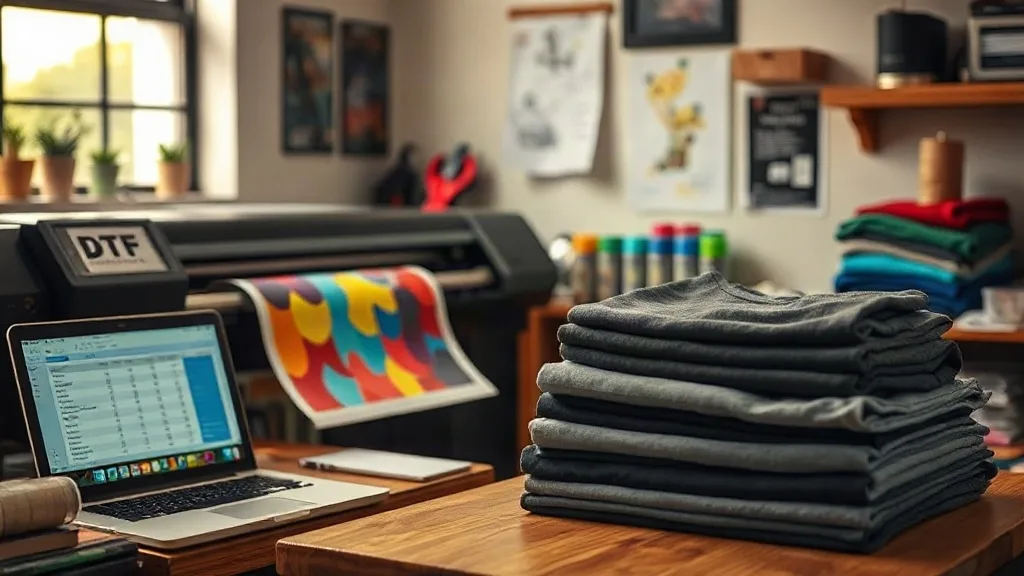
Every print shop owner eventually faces the same uncomfortable question: am I actually making money on these jobs? You finish a run of 50 shirts, invoice the client, and feel good about the deposit hitting your account. But once you subtract the blanks, the dtf transfers, the labor, and the electricity, the margin can look thinner than you expected. Pricing dtf work isn't about picking a number that feels fair. It's about understanding your real costs and building a structure that protects your profit on every order.
This guide walks through the numbers behind dtf printing, from the cost of a single transfer to the pricing models that keep small shops competitive without racing to the bottom. Whether you're just starting out or you've been running jobs for years, there's a good chance you'll find a lever you can pull to improve your margins.
Why DTF Pricing Feels So Murky
Part of the problem is that dtf printing is still relatively new compared to screen printing or embroidery, so there isn't a single industry standard for pricing. Shops charge per transfer, per square inch, per shirt, or per gangsheet, and none of those numbers mean much without context. A transfer that costs you $0.80 to produce might sell for $2.50 from one supplier and $4.00 from another, and both can be profitable depending on the volume and the service wrapped around them.
Another issue is that many shop owners don't track their costs closely enough to know what they should charge. They look at a competitor's price, shave a little off to win the job, and end up working for free. That's not a pricing strategy. That's a slow way to close a business.
The Real Cost of a DTF Transfer
Before you can price anything, you need to know what a transfer actually costs you. That number includes more than the film and the powder. Here's a realistic breakdown for a small shop producing transfers in-house:
- Film and ink: Roughly $0.15 to $0.40 per square inch depending on your printer and ink setup.
- Powder: A few cents per transfer, but it adds up across a gangsheet.
- Labor: Printing, powdering, curing, and cutting all take time. Even at a modest hourly rate, this is often the largest hidden cost.
- Equipment and maintenance: Printheads, fuser units, and general wear and tear need to be budgeted for.
- Waste: Misprints, failed transfers, and test runs all eat into your margin.
When you add those up, a transfer that looks like it costs $1.00 to make might actually cost $2.00 or more once everything is accounted for. If you're selling it for $2.50, you're not making money. You're running a charity with extra steps.
A Simple Costing Exercise
Take your last week of dtf production and add up every expense tied to it: materials, labor hours, and a fair share of your equipment costs. Divide that total by the number of transfers you produced. That's your true cost per transfer. Most shop owners are surprised by the result, and that surprise is usually the first step toward better pricing.
Pricing Models That Actually Work
There's no single right way to price dtf work, but there are a few models that tend to hold up well for small shops. The key is to pick one and apply it consistently so you're not reinventing the wheel on every quote.
Per-Square-Inch Pricing
This is the most common approach for shops that produce their own transfers. You set a rate per square inch, usually somewhere between $0.03 and $0.08 for retail customers, and multiply it by the size of the design. A 10x12 inch print, for example, is 120 square inches, which at $0.05 per inch comes out to $6.00. This model scales fairly with design size and is easy to explain to customers.
Per-Transfer Flat Rate
Some shops prefer a flat rate per transfer regardless of size, usually tiered by design category (small, medium, large). This is simpler for customers to understand and easier to quote quickly, but it can leave money on the table if you're not careful about your size tiers. A flat rate of $3.00 for a pocket logo and a full back print doesn't make sense, so build in enough tiers to stay fair to both sides.
Per-Garment Pricing
If you're selling finished shirts rather than transfers alone, pricing per garment is often the cleanest approach. You bundle the blank, the transfer, and the labor into a single price that reflects the value of the finished product. A basic tee with a one-color front print might sell for $22 to $28 depending on your market, and a premium blank with a large back print can go for $35 or more. The advantage here is that customers aren't comparing your transfer price to a supplier's; they're comparing your finished shirt to other finished shirts.
Don't Compete on Price Alone
The fastest way to destroy your margins is to treat dtf printing as a commodity and compete solely on price. There will always be someone willing to charge less, and chasing them down is a losing game. Instead, compete on things that actually matter to customers: turnaround time, print quality, design help, and reliability.
A shop that delivers a flawless 50-shirt order in three days can charge more than a shop that takes two weeks and sends half the order back for reprints. Customers pay for confidence, and confidence is worth more than a few cents per transfer.
Building a Pricing Sheet You Can Stand Behind
Once you've done the costing work, put your prices on paper and stick to them. A written pricing sheet does two things: it forces you to be consistent, and it gives customers a clear reference point so they're not haggling on every order. Include your size tiers, your minimum order, your turnaround options, and any setup or design fees. Clarity builds trust, and trust is what turns a one-time order into a repeat customer.
Review your pricing every six months or so. Material costs change, equipment gets replaced, and your time becomes more valuable as your shop grows. A pricing sheet that made sense a year ago might be leaving money on the table today.
Frequently Asked Questions
How much should I charge for a DTF transfer?
Most small shops charge between $0.03 and $0.08 per square inch for retail transfers, or a flat rate of $2.50 to $8.00 depending on size. The right number depends on your actual costs, your market, and the level of service you provide. Start with your true cost per transfer and build a margin on top of that.
Is it cheaper to make DTF transfers in-house or buy them?
It depends on your volume. At low volumes, buying transfers from a supplier is often cheaper once you account for equipment, maintenance, and labor. At higher volumes, in-house production usually wins on cost per transfer, but only if you're running the equipment efficiently and tracking your real expenses.
How do I calculate my profit margin on DTF printing?
Subtract your total cost per transfer (materials, labor, equipment, waste) from your selling price, then divide by the selling price. If a transfer costs you $2.00 to produce and you sell it for $5.00, your margin is 60%. Aim for at least 50% to leave room for overhead and growth.
Should I charge extra for design work?
Yes, if you're providing design services. Many shops include basic design help in the price of an order, but custom artwork, revisions, and complex layouts should be billed separately. Charging for design work protects your time and signals to customers that your expertise has value.
How often should I raise my DTF prices?
Review your pricing at least once a year, and sooner if your material costs rise significantly. A small annual increase, communicated clearly to customers, is usually easier to absorb than a large jump after years of holding prices steady.